
Электронные кошельки
A user who authenticates to your service using their username and password one week might choose Google Sign-In the next without understanding that this could create a duplicate account http://newsalon.ru/nwln/pgs/?chto-takoie-ts-upis-v-fonbiet-prostoie-obiasnieniie_1.html. Similarly, a user may have very good reason to link multiple email addresses to your service. If you’ve properly separated user identity and authentication, it will be a simple process to link several authentication methods to a single user.
Account management, authentication and password management can be tricky. Often, account management is a dark corner that isn’t a top priority for developers or product managers. The resulting experience often falls short of what some of your users would expect for data security and user experience.
There are a number of excellent resources available to guide you through the process of developing, updating, or migrating your account and authentication management system. I recommend the following as a starting place:
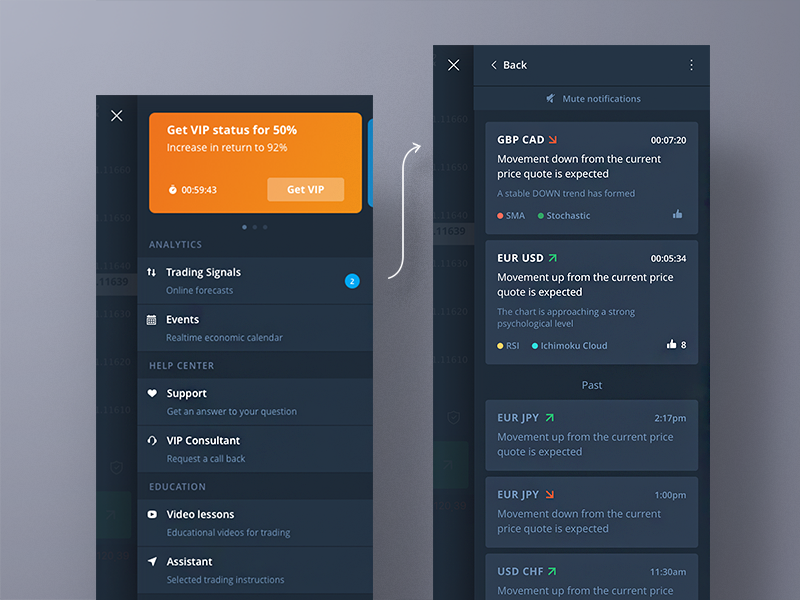
Automatic trading signals
Trade Ideas is worth it if you are a pattern day trader trading at least three times daily with an account value of over $25K as this will help you profit after paying the Trade Ideas subscription cost.
My hands-on testing confirms that Trade Ideas, TrendSpider, TradingView, and Tickeron are the clear leaders in AI stock trading algorithms and AI investing portfolios. Trade Ideas, TrendSpider, and TradingView are designed for stock trading, and all provide fully automated trading, while Tickeron specializes in AI investing and portfolio creation.
I use it to send signals when a company meets my value criteria (WC >=2:1, positive cash, P/E<25, etc.) and shows exceptional volatility in the negative direction. Then I investigate with a “human” eye. If it looks good to me, I push the trade manually.
After testing the Trade Ideas platform and assessing the AI stock trading and the day trading Bot performance, I can say this is the most compelling application of stock market AI for retail investors available today. This AI stock picker produces 3 to 10 trades daily, each lasting 2 minutes to 3 hours.
Hypothetical performance results have many inherent limitations, some of which are described below. No representation is being made that any account will or is likely to achieve profits or losses similar to those shown; in fact, there are frequently sharp differences between hypothetical performance results and the actual results subsequently achieved by any particular trading program. One of the limitations of hypothetical performance results is that they are generally prepared with the benefit of hindsight. In addition, hypothetical trading does not involve financial risk, and no hypothetical trading record can completely account for the impact of financial risk of actual trading. for example, the ability to withstand losses or to adhere to a particular trading program in spite of trading losses are material points which can also adversely affect actual trading results. There are numerous other factors related to the markets in general or to the implementation of any specific trading program which cannot be fully accounted for in the preparation of hypothetical performance results and all which can adversely affect trading results.
Transparent trading conditions
World Economic Forum articles may be republished in accordance with the Creative Commons Attribution-NonCommercial-NoDerivatives 4.0 International Public License, and in accordance with our Terms of Use.
This is the promise and potential of the UN Economic Commission for Europe (UNECE) Policy Recommendation No. 49, slated for discussion at the UN Centre for Trade Facilitation and Electronic Business (UN/CEFACT) Plenary in July 2024. UNECE Recommendation No.49 “Transparency at Scale” will serve as a framework for globally scalable supply chain transparency that supports any Environmental, Social, and Governance (ESG) criteria required for a product by either an ESG standard or a regulation.
GS1 is the company behind most barcodes on every product on the supermarket shelves and has defined digital link protocols to discover information, given a product identifier. UNTP is designed to be compatible with organizations’ existing GS1 infrastructure including the use of barcodes and other means of product identification based on GS1 standards, the most widely used system of standards for product identification in the world. UNTP, however, is not confined only to GS1 standards and is extendable to other product identifier infrastructures. The UNTP will provide the cross-border upstream data to support existing regulatory passports and those in development. It will also provide the interoperable cross-industry core to support industry-specific digital passports.
Consumer, investor, employee, regulatory and market expectations are evolving rapidly, with an increasing emphasis on ESG practices. Ultimately, commercial value relies on consumer trust and behaviour.